Buy or rent in Israel: the arithmetic, not the advice
Guide · The decision
Buy or rent in Israel: the arithmetic, not the advice
Everybody arrives certain they should buy immediately, or certain they should rent for two years. Both camps are usually arguing from instinct. Here is the calculation that actually decides it, and the specific Israeli facts that make the answer different from the one you would get at home.
Why the usual rule of thumb fails here
In most Anglo markets, renting looks like waste and buying looks like discipline, because rents are high relative to prices. Israel is the other way round. Gross rental yields in central Israel commonly sit somewhere around two and a half to three and a half per cent — low by international standards — which means renting is comparatively cheap and owning is comparatively expensive to carry.
The flip side is that Israeli property has, over long periods, appreciated in a way that made the carry irrelevant in hindsight. That is a statement about the past. It is not a forecast, and anyone who offers you one should be treated accordingly.
What the calculation actually is. Compare the cost of renting for your holding period against the cost of owning for the same period — mortgage interest, arnona, va'ad bayit, insurance, maintenance, and the round-trip transaction costs of buying and selling — and set the difference against the capital you would otherwise have invested elsewhere. Appreciation is the last term in the equation, not the first.
The costs of buying, honestly listed
Add it up and a round trip commonly costs seven to nine per cent of the price. That is the number that decides whether a short hold makes sense, and short holds mostly do not.
The mortgage rules that constrain the decision
Bank of Israel limits are hard limits, not guidance. An Israeli resident buying a single apartment can borrow up to 75% of value; buying a replacement home, 70%; buying an additional or investment property, 50%. A non-resident is capped at 50% whatever the purpose — which is the single most common reason a plan made abroad falls over.
Rates matter too. The Bank of Israel cut to 3.5% on 6 July 2026, taking prime to 5%, after a cut to 3.75% in May. Israeli mortgages are usually built as a mix of tracks — prime-linked, fixed unlinked, and CPI-linked fixed or variable — and the CPI-linked tracks are the ones that catch foreign buyers out, because the principal itself rises with the index.
The case for renting first
- You do not know where you want to live. This is the real argument, and it wins more often than the financial one. Anglo buyers routinely choose an area for its community and discover the commute, or choose for the commute and discover the community. A year of renting is cheap tuition.
- Your entitlements have a clock on them, and it is generous. The oleh purchase tax route is not a thing you must use in your first month.
- You are not yet mortgageable. Israeli banks want to see Israeli income, or a significant equity contribution, before lending on ordinary terms.
- Liquidity. Selling an Israeli apartment is not fast. If there is any real chance you go back, do not tie up the money.
The case for buying now
- You are certain about the area. If you have lived there, or family is there and you are joining them, the main argument for renting evaporates.
- You are buying off-plan for delivery in three or four years. You rent anyway during construction, so the decision is not really buy-versus-rent — it is buy-now versus buy-later at an unknown price.
- Rent is dead money in a specific sense. Not in the sloppy sense people use, but in the sense that low yields mean the rent you pay is small relative to the asset — which also means the landlord's return is small, and he will raise it when he can.
- You have the cash and no borrowing constraint. Then the transaction costs are the only real friction and the analysis simplifies considerably.
A worked frame you can fill in yourself
Take the apartment you would buy. Work out the annual cost of owning it: mortgage interest in year one, plus arnona, plus va'ad bayit, plus insurance, plus one per cent of value for maintenance. Now take the annual rent on the same apartment. The gap between them is what owning costs you per year in cash terms before any capital movement.
Then take the round-trip transaction cost — call it eight per cent — and divide it by the number of years you intend to hold. That is the annual drag. Add the two. The result is the annual rate of appreciation the property has to deliver just to make you even against renting. Write that number down. If it is higher than you would honestly forecast, you are buying for reasons other than the arithmetic, which is allowed — but you should know you are doing it.
Buy or rent — running the numbers on a real apartment
One apartment, both routes, five years of arithmetic on screen.
Nothing on this page is legal, tax or financial advice.
Questions we get asked
Do I lose my oleh purchase tax entitlement if I rent first?
No. The oleh route under Regulation 12A is not spent by renting. What matters is your status and whether the apartment is your only one — check your own position with a lawyer, because the conditions are specific.
Can I get an Israeli mortgage while living abroad?
Yes, and Israeli banks lend to non-residents routinely — but at a maximum 50% loan to value, with more documentation and usually a higher margin. Plan the deposit around that number, not around what you could borrow at home.
Is it cheaper to buy in a cheaper city and rent it out?
It can be, but check net yield rather than gross: arnona in an empty month, va'ad bayit, management, void periods, repairs and Israeli tax on the rent. Headline yields in peripheral cities look attractive and frequently do not survive the deductions.
How long does buying take from abroad?
On a resale, typically two to four months from agreed price to keys, longer if the seller has a mortgage to discharge or a Tabu registration problem. Off-plan is a different animal entirely — years.
What is the biggest financial mistake foreign buyers make here?
Committing to a price before confirming the maximum they can borrow as a non-resident, and treating CPI-linked mortgage tracks as though the principal were fixed.
The numbers are city by city, not national
A national average tells you almost nothing about the apartment you are looking at. We publish a quarterly reading for each of the eighteen cities the Central Bureau of Statistics covers, with every figure sourced.
This is general information about property in Israel, not legal, tax or financial advice. Figures, thresholds and procedures change, and every transaction turns on its own documents. Take advice from an Israeli lawyer on your own contract before you sign anything or send any money.
This index publishes data and takes no money from anyone it writes about. No advertising, no paid placement, no sponsored entries, and no referral or introduction fee from any agent, developer, bank, lawyer, surveyor or mortgage broker named anywhere on this site. It is not a licensed brokerage, it holds no listings, and no property is sold through it.
Bringing money into Israel: the declaration, the paper trail, the mistakes
Guide · Money
Bringing money into Israel: the declaration, the paper trail, the mistakes
There is no limit on how much money you may bring into Israel. There is a hard obligation to declare it above a threshold, and a much harder practical problem: an Israeli bank will not let you spend money it cannot trace.
The declaration rule
Section 9 of the Prohibition on Money Laundering Law requires anyone entering or leaving Israel to report funds they are carrying above the reporting threshold: ₪50,000, or ₪12,000 when crossing a land border. It is done on Customs Form 84, on the red route, at the crossing.
Two details catch people. "Funds" is not just banknotes — it covers coins, bank cheques and traveller's cheques. And travelling as a family does not divide the threshold: if one passenger holds more than the threshold he reports, and if several passengers jointly own funds that total more than the threshold, that must be reported too.
The old oleh relief is gone. Before the 2017 amendment, an immigrant entering for the first time only had to report at ₪1,250,000. That relief was abolished. New olim now declare above ₪50,000 like everyone else. Guides written before 2018 — and there are many still online — get this wrong.
Declaring is not taxable and does not trigger an investigation. Failing to declare can mean seizure of the funds, a financial penalty, or criminal proceedings.
The real obstacle is not customs, it is the bank
Physical cash is the small problem. The large one is that Israeli banks operate strict anti-money-laundering procedures and will ask, at the moment you try to move a large sum into a property purchase, where it came from. Answering that question badly stops a transaction dead, sometimes for weeks.
What the bank generally wants to see is a documented chain from a source it recognises to the account it is arriving in:
- Sale of a property abroad — the completion statement, the lawyer's letter, the bank statement showing the proceeds arriving.
- Employment or business income — payslips, tax returns, accounts.
- A gift from family — a signed gift letter, the giver's identification, and evidence of the giver's own source of funds. This is the one that most often goes wrong.
- Inheritance — grant of probate, the executor's distribution statement.
- Investment proceeds — broker statements showing the sale and the transfer out.
Assemble this before you need it, not when the bank asks. On a purchase, send the pack to your Israeli lawyer at the same time you instruct him.
How the money should actually travel
On timing: on a large sum the exchange rate matters more than the fee. A one per cent difference on a purchase deposit is worth more than every transfer charge you will pay in a decade.
If you are buying before you are resident
A foreign resident can buy Israeli property and can hold an Israeli bank account, but both attract more documentation than a resident's. Expect the bank to ask for proof of address, tax residency declarations, and — if you are a US person — FATCA forms. Build three to four weeks into your timetable for account opening alone, and do not agree a completion date that assumes it happens in a fortnight.
Getting your money into Israel and into a deal
What the bank asks for, and why deals stall at exactly this point.
Nothing on this page is legal, tax or financial advice.
Questions we get asked
Do I have to pay tax on money I bring into Israel?
Bringing capital in is not itself a taxable event. What matters is whether the income or gain that produced it is taxable, and where — which is a question about your tax residence and any treaty, not about the transfer.
Can my parents transfer the deposit for my apartment?
Yes, and it is common. The bank will want a signed gift letter and evidence of the giver's own source of funds. Sort that out before the money moves; retro-fitting it is much harder.
Is there a limit on taking money out of Israel again?
No limit, but the same ₪50,000 declaration threshold applies on the way out, and moving sale proceeds abroad requires tax clearance.
Should I convert to shekels before or after transferring?
Compare the total cost — spread plus fee — of converting with a broker abroad against converting at the Israeli bank on arrival. On a property-sized sum the broker route is usually cheaper, but get the quote in writing.
What is the single most common failure?
Money arriving in an Israeli account from a third party the buyer cannot document — a business partner, a relative's company, an exchange house. The funds are then frozen pending explanation, mid-transaction.
Work out the tax before you work out the budget
Purchase tax is the largest single cost on the way in and it differs sharply by buyer type. The calculator runs all four — oleh, resident single home, resident additional, foreign resident — side by side.
This is general information, not legal, tax or financial advice. Israeli tax rules changed materially for people becoming resident from 1 January 2026, and figures are revised annually. Take advice from an Israeli accountant on your own position before you act, and confirm current thresholds with the Israel Tax Authority.
This index publishes data and takes no money from anyone it writes about. No advertising, no paid placement, no sponsored entries, and no referral or introduction fee from any agent, developer, bank, lawyer, surveyor or mortgage broker named anywhere on this site. It is not a licensed brokerage, it holds no listings, and no property is sold through it.
Arnona: the municipal tax nobody budgets for
Guide · Running costs
Arnona: the municipal tax nobody budgets for
Arnona is charged on the area of your apartment, not its value, which means two identical families in identical apartments can pay very different amounts depending on which side of a municipal boundary they live. It is also one of the few Israeli bills where new olim get a large, time-limited discount.
How the charge is built
Arnona (arnona) is levied by the municipality, not the state. Each city sets its own rate per square metre, publishes it annually, and applies it to the registered area of your property according to a classification — residential, commercial, storage, parking — and often to a zone within the city.
Three consequences follow. Your bill has nothing to do with what you paid for the apartment. A balcony, a storeroom or a covered parking space may be counted into the area, depending on the municipality's rules. And moving one street across a boundary can change the bill materially, which is worth knowing before you choose between two adjacent towns.
Check the registered area, not the marketing area. Municipalities charge on their own measurement. If the city has you down for more square metres than you have, you can challenge it — and people do, successfully. Ask for the measurement on which your assessment is based.
The oleh discount
New olim are entitled to a substantial arnona discount: up to 90 per cent, on up to 100 square metres, for twelve months, to be used within the first twenty-four months from the date of aliyah. It is not applied automatically. You claim it at the municipal offices with your teudat oleh and teudat zehut, and you claim it in the twelve months you choose.
That last point is the one people waste. Because you choose which twelve of the first twenty-four months to use, it is worth spending the discount on the year you are actually liable for a full-size apartment rather than on months you spend in temporary accommodation or abroad.
Other discounts worth asking about
Every one of these is claimed, not given. The municipality will not find you.
Paying it, and who pays it
Arnona is billed bi-monthly — six payments a year — and most residents set up a direct debit (hora'at keva). Paying the whole year in advance usually earns a discount of a few per cent, which is the best guaranteed return available on a small sum of money.
In a tenancy, arnona is normally the tenant's and the account is transferred into his name for the term. Do this properly: the municipality needs a copy of the lease and both parties' details, and an outstanding arnona debt attaches to the property in a way that surfaces awkwardly at sale. If you are buying, confirm the arnona account is clear as part of tax clearance before completion.
If you think the bill is wrong
You can object. The route is an objection (hasagah) to the municipal arnona manager within a defined window from the date of the assessment, on specified grounds — that you are not the holder of the property, that the area is wrong, or that the classification is wrong. From there an appeal lies to an appeals committee and onward to the courts.
The practical advice is duller than the legal route: measure the apartment, obtain the municipality's measurement, and put the two side by side before you write anything. Most successful challenges are arithmetic, not argument.
What a city actually charges — arnona compared across the Anglo areas
The bill, the bands and the discounts, city by city.
Nothing on this page is legal, tax or financial advice.
Questions we get asked
Is arnona included in my rent?
Sometimes, and the contract must say. The default expectation in Israel is that the tenant pays arnona directly, with the account in his name for the term.
Do I pay arnona on an apartment I own but do not live in?
Yes. The holder of the property is liable, and an empty apartment still attracts the charge, though a genuinely empty and unfurnished one may qualify for a time-limited reduction on application.
Can I claim the oleh discount if I am renting?
Yes — the discount attaches to you as a new oleh in respect of the property you hold, so a tenant with the arnona account in his name can claim it. Bring your teudat oleh.
Does the discount apply to my whole apartment?
Up to 100 square metres. Above that, the excess area is charged at the full rate.
How much is arnona, roughly?
It varies enormously by city and zone, which is exactly why a national figure is useless. Ask the municipality for the current residential rate per square metre for the specific street, and multiply.
Running costs are a reason people move again
Arnona, va'ad bayit and the commute are what turn a good apartment into the wrong one. Every area profile states them plainly, including where the answer is unflattering.
This is general information about property in Israel, not legal, tax or financial advice. Figures, thresholds and procedures change, and every transaction turns on its own documents. Take advice from an Israeli lawyer on your own contract before you sign anything or send any money.
This index publishes data and takes no money from anyone it writes about. No advertising, no paid placement, no sponsored entries, and no referral or introduction fee from any agent, developer, bank, lawyer, surveyor or mortgage broker named anywhere on this site. It is not a licensed brokerage, it holds no listings, and no property is sold through it.
Market analysis · Second quarter 2026
Market analysis · Second quarter 2026
Prices fell, sales held, and the two halves of the market stopped moving together
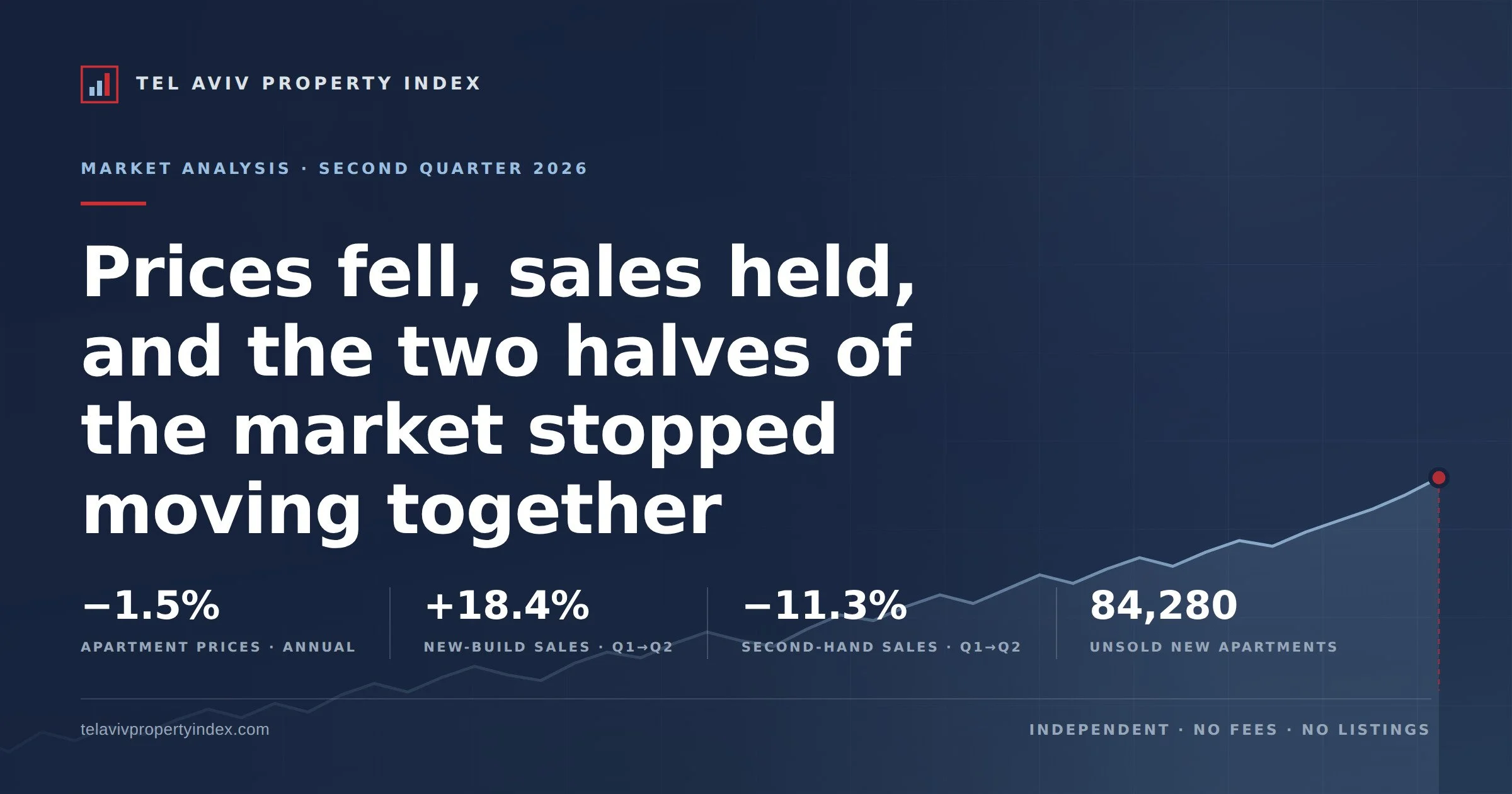
Israeli apartment prices ended the second quarter about one and a half per cent below where they were a year earlier. That single number hides almost everything that actually happened between April and June — a four-and-a-half point spread between districts, new-build sales up eighteen per cent while second-hand sales fell eleven, and building costs still climbing while the asset they produce gets cheaper.
The number itself
There is no single Q2 price figure, and anyone who quotes one is rounding something off
The Central Bureau of Statistics does not publish a quarterly house price number. It publishes a rolling index that compares transactions in two months against transactions in the two months before, released roughly six weeks in arrears. Three of those readings touch the second quarter, and they were published on 15 June, 15 July and 14 August.
They read: −0.3% for March–April, −1.0% for April–May, and +0.1% for May–June.
You cannot multiply those three readings together to get a quarterly figure.
Each window overlaps the next by a full month, so April is counted twice and May three times. Compounding them produces roughly −1.2%, which is arithmetic rather than a fact about the market. It is a common mistake in Israeli property commentary and it always exaggerates the move.
The honest quarterly proxy is the twelve-month comparison, which does not overlap itself. Across the three Q2 readings it ran −1.3%, then −2.0%, then −1.5%. So the year-on-year decline deepened through the middle of the quarter and then eased. Prices are drifting down at somewhere between one and two per cent a year, which after five years in which the index rose about a third is a stall, not a correction.
Two other things are worth holding in mind before reading any of this too confidently. The figures are provisional — transactions reported late to the Tax Authority revise them, usually by a tenth or two. And the start of the quarter sat in the shadow of the March–April confrontation with Iran, which the Bank of Israel says produced a sharp fall in activity that the economy then spent the rest of the quarter recovering from. April was not a normal month.
Where it happened
The national figure is an average of six markets that are no longer doing the same thing
Take the mid-quarter annual reading — April–May 2026 against April–May 2025 — and the national −2.0% breaks into a spread of 4.6 percentage points. The Centre district was down 3.2% on the year. The North was up 1.4%.
The month-to-month district numbers are noisier still, and they invert. In the May–June reading Jerusalem was up 1.8% and Haifa up 1.5%, while the Centre was down 1.0% and Tel Aviv down 0.7% — roughly the reverse of what those same districts had done a month earlier. District-level readings sit on far fewer transactions than the national index, so a couple of unusual buildings can move them. Treat the annual figures as signal and the two-month district swings as weather.
What survives both is the direction. The Centre and Tel Aviv — the two most expensive districts, and the two carrying the most unsold new stock — are where the falls are concentrated. The periphery is flat to rising.
What actually traded
Total sales barely moved. What was being sold changed completely
About 22,640 apartments changed hands in April–June, 0.6% fewer than in the first quarter, or 14.9% more once the CBS adjusts for seasonality. On the face of it, a quiet quarter. Underneath, the composition moved hard in one direction.
New-build sales rose 18.4% on the quarter, to about 9,670. Second-hand sales fell 11.3%, to about 12,970. New build took 42.7% of the market, against roughly a third a year ago. Tel Aviv district sold 2,302 new apartments, up 49.9% in three months; Tel Aviv-Yafo itself sold 1,236, up 50.7%. Ashdod went from 145 new-build sales to 509.
This is not the same thing as a recovering market, and it is worth being precise about why. Second-hand sellers fell in every district — Jerusalem down 20.3%, Haifa 14%, Tel Aviv 12.6%. A private seller cannot offer you 20/80 terms, cannot absorb your index linkage, and cannot subsidise your mortgage. Developers sitting on unsold stock can do all three, and in the second quarter they did. Roughly a third of new-build sales — 32.7% — went through government subsidy schemes, and in the price index the subsidised share of new transactions rose again, from 36.4% to 38.4%.
Strip the government support out and the new-build price series has been falling, not rising.
The CBS ran exactly that test earlier in the year: new-build prices up 0.4% on the headline, down 0.3% once transactions with government support were excluded. Over the year to April–May, new-build prices were down 3.9% — roughly double the fall in the market as a whole.
The overhang
Eighty-four thousand new apartments are still waiting for a buyer
The stock stood at about 84,280 unsold new apartments at the end of June, against roughly 85,300 in March and around 65,000 in April 2024. After three and a half years of the pile growing at about 1.4% a month, it has been broadly flat since the turn of the year. Months of supply improved to 26, from 28.9 at the end of May — which is what the strong new-build quarter bought.
Where it sits matters more than the total. Tel Aviv district holds 30.2% of the national overhang and the Centre another 24.4%: more than half the unsold stock is in the two districts buyers most want to be in, and those are the two districts where prices fell hardest over the year. Among the large cities, Jerusalem has about 10,320 unsold new apartments and Tel Aviv-Yafo about 9,550. Outside them, the concentrations are striking for the size of the towns — Lod around 3,050, Kiryat Gat 2,610, Yehud-Monosson 1,810, Be'er Ya'akov 1,570, Ramat HaSharon 1,510, Ra'anana 1,500.
Two years of supply is the number that explains the incentives. A developer carrying finance on unsold stock has a monthly cost of waiting, and discounting is usually cheaper than waiting. That is the mechanism behind the payment terms currently on offer — not generosity, and not confidence.
The squeeze
Costs are rising into falling prices, and the gap is now about five points
The construction inputs index rose 0.2% in June and 3.7% over the year. Almost all of that is labour: site wages were up 5.5%, and stripped of wages the index did not move at all in June. Concrete actually fell. So the cost pressure in Israeli construction right now is people, not materials, and it is not obviously about to ease.
Meanwhile the thing being built is 1.5% cheaper than a year ago, and if it is a new-build apartment, 3.9% cheaper. Developers are absorbing a squeeze of roughly five percentage points a year between what they pay and what they can charge. Everything else in this quarter's data — the financing promotions, the subsidised share, the rise in cancellations of purchases from developers — follows from that one gap.
For anyone buying off-plan, that scissors chart is not background. It is your contract.
Payments on an off-plan purchase are linked to the construction inputs index. On a contract signed since 7 July 2022, at least 20% is payable at signing without linkage and only half of each further payment may be linked, so the practical ceiling on linked exposure is about 40% of the price. On a ₪2.5m apartment that is around ₪1m riding an index rising 3.7% a year, while the asset itself is drifting down. Worth knowing before the payment schedule is agreed, not after.
Money
Only one rate cut landed inside the quarter — and the one everyone talks about did not
The Bank of Israel began easing in November 2025 and has cut four times since. Inside the second quarter itself there was exactly one move: late May, from 4.00% to 3.75%. Two of the quarter's three months transacted at 4.00%.
The cut to 3.50% came on 6 July, after the quarter closed, taking prime to 5%. It appears in none of the figures above. Anyone reading the June uptick as the rate cuts working is a quarter early — the July move will first show up in the August–September index, published in November.
The Bank's own forecast, published alongside the July decision, has inflation at 1.8% for 2026 and the policy rate averaging 3% by the second quarter of 2027, implying two more cuts. Growth was revised up to 4% for 2026. If that path holds, the affordability picture improves gradually through 2027 — but gradually is the operative word, and a hundred basis points spread over eighteen months does not move an asset price much on its own.
| Reading | Period covered | Published | Two-month | Annual |
|---|---|---|---|---|
| Q1 close | February–March 2026 | 15 May 2026 | +0.4% | −1.2% |
| Q2 first | March–April 2026 | 15 June 2026 | −0.3% | −1.3% |
| Q2 middle | April–May 2026 | 15 July 2026 | −1.0% | −2.0% |
| Q2 close | May–June 2026 | 14 August 2026 | +0.1% | −1.5% |
All CBS price readings are provisional and subject to revision as late transactions are reported.
What a buyer should take from it
Six conclusions that follow from the data, and one that does not
-
This is a stall, not a crash
One to two per cent a year, after a third of a decade's gains, against inflation of 1.6%. In real terms it is a slow deflation of about three per cent a year. Anyone waiting for a 20% correction is waiting on something the data does not currently point at.
-
Negotiating power is real, and it is unevenly distributed
It sits where the unsold stock sits: Tel Aviv district, the Centre, and a handful of towns carrying more inventory than their size suggests. It is much weaker in the North and in Jerusalem, where prices held or rose.
-
The best terms are on new build, and terms are not the same as price
A 20/80 structure with the developer carrying the linkage is worth real money. A headline discount on a price that was set optimistically is worth less. Compare against what has actually transacted in the building, not against the price list.
-
Second-hand is where the quiet opportunities are
Sales fell in every district, which means private sellers are meeting fewer buyers than at any point this year. A seller who has already committed to moving has a problem that a developer with 84,000 units of company does not.
-
Off-plan linkage is a live cost, not a footnote
Build costs are rising 3.7% a year into prices falling 1.5%. If you are signing a payment schedule, the split between linked and unlinked payments is worth more attention than the kitchen specification.
-
The rate cuts are not in these numbers yet
Only one landed inside the quarter. The July cut to 3.50% first appears in data published in November. If cheaper money is going to put a floor under prices, Q2 is too early to see it.
The conclusion that does not follow: that the strong new-build quarter marks the turn. The CBS says so itself — new-build sales have risen an average of 2.7% a month since January while second-hand has fallen 0.4% a month since April, and it is too early to call that a reversal rather than a transfer between the two halves of the same market. One quarter of subsidised, incentivised new-build sales is not a recovery until the second-hand market joins it.
Sources and method
- Apartment price index, and new-build index: Central Bureau of Statistics releases of 15 May, 15 June, 15 July and 14 August 2026. Index covers new and second-hand transactions across 67 localities in nine areas, drawn from Tax Authority records rather than survey. All readings provisional.
- Transaction volumes, district and city breakdowns, and unsold stock: CBS release of 13 August 2026 covering the second quarter and stock at 30 June 2026.
- Construction inputs index and wage component: CBS price-of-inputs release for June 2026 (base July 2025 = 100), with the July 2026 reading noted where relevant.
- Policy rate, macroeconomic forecast and the assessment of March–April activity: Bank of Israel Monetary Committee decision and accompanying forecast, 6 July 2026.
- Monthly purchaser breakdowns and subsidy shares: Ministry of Finance, Chief Economist, residential real estate reviews for the relevant months.
- Q1 volume figures in Figure 3 are derived from the published quarter-on-quarter percentage changes and rounded; they are not separately published in that form.
General market commentary, not legal, tax or investment advice, and not a recommendation to buy or sell any particular property. Figures are current at 20 August 2026 and will be revised.
This index publishes data and takes no money from anyone it writes about. No advertising, no paid placement, no sponsored entries, and no referral or introduction fee from any agent, developer, bank, lawyer, surveyor or mortgage broker. It is not a licensed brokerage, it holds no listings, and no property is sold through it.
One quarter is not your street
A national figure is six markets averaged, and yours is one street
Send us the street, the price you have been quoted and the stage you are at, and we will tell you what the recorded transactions on it look like. We are not selling you the apartment and we are not paid by anyone who is.
Tel Aviv market note · September 2026
Four markets, one city. The index is down. The average cheque is not.
CBS quality-adjusted prices in the Tel Aviv district have slipped. The average flat that actually traded in the city of Tel Aviv has not. New-build stock is heavy. Prime second-hand streets still clear. Those four facts are the whole story. The charts below use the same non-overlapping CBS anchors as the value tracker — not rolled two-month prints stacked on top of each other.
The like-for-like home is not the average sale
CBS’s quality-adjusted dwelling index tracks a given home. It is the series that answers “what is this flat worth.” From a common 100 in 2021 Q2, the national path peaks in 2024 Q4 and is now slightly off that high. Tel Aviv district ran hotter through 2022, took a harder 2023 (−3.7% on the Bank of Israel district annual), bounced in 2024, then printed its first down year in six years in 2025. May–June 2026 is still −1.7% on the year.
That is not what the average cheque says. In Q2 2026 the city average transaction was ₪4.55 million, up about 8.4% on a year earlier. A four-room flat in the city cleared over ₪5 million. Herzliya four-room ~₪3.43m, Ramat Gan ~₪3.07m. The gap is mix: more new, larger, mamad-equipped stock in the sold sample, fewer cheap second-hand deals.
Both series start at 100 in 2021 Q2. Quarters between published year-end / y/y anchors are geometric interpolation. Do not quote an interpolated quarter as a CBS print. Five-year national Q2-on-Q2 is +30.6%, the CBS all-dwellings figure.
The country is not moving as one district
May–June 2026 versus the same window in 2025: Jerusalem and the North are still up. The Centre is the problem child at −4.1%. Tel Aviv district sits with the national print, a little weaker. If you only read “Israel is down 1.5%,” you miss that a flat in Modiin and a floor in Nachlaot are not in the same cycle.
Source: CBS May–June 2026 district y/y, quality-adjusted. Tel Aviv here is the district, not the municipal boundary.
Inside the city, second-hand already took the cut
A deal-level study of second-hand sales from January 2023 to mid-July 2026 (371 transactions, flats older than five years) is the useful street-level chart. Lev HaIr (Rova 3) median shekels per metre is down 23.3%. Old North (Rova 4) is down 7.8%. The 60–80 m² band in Rova 4 — the classic oleh three-room — fell 14.8%. Large units held up better. In real shekels, after CPI, every one of those cuts is deeper.
South and east of the city did not fall the same way in 2024–25. The premium of a Tel Aviv four-room over the rest of the country has been shrinking since 2023. That is the stock most foreign buyers actually bid on: older 3–4 rooms without a contractor campaign behind them.
New-build is the overhang. Rates are not the story.
Bank of Israel has been cutting, toward 3.5% by July 2026. Money is cheaper. Prices still slip because supply is the constraint, not the last 25 basis points.
- City of Tel Aviv: about 9,500–9,800 unsold new flats.
- Tel Aviv district: about 25,300–25,400 unsold new flats — roughly 30% of the national pile.
- At spring sales pace that was ~51 months of district supply against ~29 months nationally.
- Starts in the city still ran hot: ~7,100 dwellings begun in the year to March 2026, +23%.
Developers have been buying volume with financing deals, not sticker cuts. May 2026 new-home sales in the city jumped on campaigns; second-hand volume in the same city printed one of its weakest two-year readings. About 70% of Tel Aviv buyers who cancelled — usually a permit condition that never arrived — did not buy another flat. That is demand stepping out, not rotating.
CBS stock of new dwellings remaining for sale, months of supply at then-prevailing quarterly sales. National inventory peaked near 86,090 at end-2025 and has been roughly stable since.
Luxury is thin, not cheap. Rent is the other market.
Q1 2026: only 20 deals above ₪15 million nationwide, a four-year low. Average luxury ticket down (₪18.3m versus ₪21.4m a year earlier), shekels per metre up 22% to about ₪87k — fewer villas in Herzliya and Caesarea, more compact prime apartments in Tel Aviv and Jerusalem. Aviv’s Herbert Samuel tower: 20 sales through end-2025 at ₪128–145k/m², zero sales in the first half of 2026. The foreign bid for that band has not come back in size. Treat glossy “luxury is up 9% YTD” notes as a different market from CBS.
Rent is the split screen. Housing-services inflation is still running near 3.5% while sale prices fall. Empty flats in core Tel Aviv are scarce. Class A offices: Begin / Sarona / Yigal Allon firmer and the city near 99% occupancy; Rothschild / Ahad Ha’am softer. That supports some live-work demand in the east. It does not set the asking price of a Rova 4 three-room.
| Slice | What it is doing | Who feels it |
|---|---|---|
| Like-for-like value, district | Soft, about −2% y/y | Anyone quoting “the market” |
| Average cheque, city | High, mix-driven, ₪4.55m in Q2 | Headlines, not valuations |
| New-build, city and district | Buyer-leaning, long inventory | Negotiate on terms and financing |
| Prime resale · Old North, Neve Tzedek, Ramat Aviv | Tighter than the index | Terms more than a crash |
| Lev HaIr second-hand | Already marked down hard since 2023 | The 60–80 m² band especially |
| ₪15m+ waterfront | Thin bid, foreign bid missing | Developers eating carry |
| Renting in the core | Still a landlord’s market | Yield vs vacant months |
Price paths use the CBS quality-adjusted dwelling-price index, rebuilt from non-overlapping anchors (Q4-on-Q4 and the published 2026 y/y windows). A national or district index is not a valuation of any particular property and ignores purchase tax, betterment, fees, financing and rent. Average transaction prices move with the mix of what sold. Months-of-supply figures move with the last quarter’s sales pace. Neighbourhood ₪/m² cuts are Gastfreund’s second-hand sample, not CBS. Nothing here is advice on a transaction.
Figures current as of the May–June 2026 CBS dwelling-price release and Q2 2026 average-price tables. Next CBS two-month window due mid-September 2026.
Tel Aviv district, five years
What ₪4,000,000 of Israeli property has actually been worth
Every quarter from Q2 2021 to the last published reading, carried by the CBS dwelling price index — national or Tel Aviv district — then converted at the exchange rate on that day. The foreign lines move on both the market and the shekel, and lately those two have pulled in opposite directions.
The holding, quarter by quarter
Today, live
Waiting for a rate.
Every quarter
Two CBS quality-adjusted dwelling-price series sit on the same quarter grid. The index tracks the value of a given home rather than the average price paid. The CBS publishes no quarterly figure: it is a two-month rolling index about six weeks in arrears, and the readings overlap, so multiplying them double-counts months and overstates the move. Both paths are therefore built only from anchors that do not overlap themselves. Quarters between anchors are geometric interpolation, marked int. in the table; they are shape, not readings, and should not be quoted as CBS numbers. All CBS price data is provisional and revises as late transactions register.
National anchors: Q4-on-Q4 +13.14% (2021), +14.68% (2022), −1.00% (2023), +7.67% (2024), −0.99% (2025); March 2026 y/y −1.28%; May–June 2026 y/y −1.50%. The path reproduces the CBS five-year figure of +30.6% for all dwellings from May–June 2021 to May–June 2026 exactly.
Tel Aviv district anchors: Dec 2021–Jan 2022 y/y +12.8%; Nov–Dec 2022 y/y +16.5%; Bank of Israel district annual for 2023 −3.7%; Nov–Dec 2024 y/y +9.4%; Nov–Dec 2025 y/y −1.9%; Feb–Mar 2026 y/y −3.5%; May–June 2026 y/y −1.7%. The 2021 second-half shape follows the national intra-year split, because CBS does not print a clean district reading at 2021 Q2. Tel Aviv district is not the city of Tel Aviv alone — it includes Bat Yam, Holon, Ramat Gan, Giv’atayim, Bnei Brak and the rest of the district.
The real column deflates by Israeli CPI, derived from the published nominal and inflation-adjusted pairs for the same years and 1.5% for 2026. Foreign-currency figures are always nominal. Switching to Real changes only the shekel column. Foreign amounts are the nominal shekel value converted at that quarter’s rate; they carry no adjustment for inflation in the buyer’s own country, so a dollar five years ago and a dollar today are not two comparable dollars, and the foreign columns flatter the real return by roughly that country’s inflation over the period.
Exchange rates are European Central Bank reference rates, retrieved live. Where a quarter end falls on a weekend or holiday the last published fixing before it is used. If the rate service cannot be reached the foreign columns are left blank rather than filled from a stale or assumed rate.
Nothing here accounts for purchase tax, betterment levy, agent or legal fees, financing, rental income, arnona, va'ad bayit, maintenance or the cost of selling. A national index is not a valuation of any particular property, and this page is a comparison tool, not advice on a transaction.
Off-Plan Linkage Exposure
Tel Aviv Property Index · Off-plan
Forty per cent of your off-plan price is not fixed
Buy an apartment before it is built and part of the price you agreed travels with the construction inputs index until the day the developer is contractually due to hand you the keys. The law caps how much. It does not remove it. Here is what the uncapped part costs, in shekels.
What the law actually says
Amendment 9 to the Sale (Apartments) Law 5733–1973 came into force on 7 July 2022 and applies to contracts signed from that date. It did three things.
- 1
At least 20% at signing, unlinked
A fifth of the price falls due when you sign, and that fifth carries no linkage at all. It is the only part of the price you can be certain of on the day you agree it.
- 2
Half of every later payment, at most
Of each payment after signing, no more than half may be tied to the construction inputs index. Half of the remaining 80% is 40% — the ceiling on your exposure, and the number most contracts run right up to.
- 3
Linkage stops at the contractual delivery date
Linkage runs to the delivery date in the contract, not the day the building is finished. A developer who runs eight months late carries the index for those eight months. You do not.
Payment timing is set separately, by the Sayag Regulations 5735–1975, which tie what a developer may collect to the construction stage actually reached. Everything below assumes a schedule shaped by those rules.
Where the exposure sits in the schedule
The signing payment is safe. Every payment after it is half exposed, and the exposure grows the further from signing the payment falls — because the index has had longer to move.
Figure 1 — stage payments on a ₪3,000,000 contract, 36-month build
Schedule shown is a conventional Sayag-shaped one. Yours will differ; the shape of the argument will not.
What it costs while you wait
The construction inputs index rose 3.7% in the year to June 2026. Carry that rate across a three-year build and the linkage adds ₪79,302 to a ₪3,000,000 apartment — money that is not in the price on the brochure, not in your mortgage approval, and not usually in the buyer’s arithmetic until the second or third payment lands.
Figure 2 — cumulative linkage cost, three index paths
Build length is the variable nobody negotiates
Buyers argue about the price and accept the delivery date. The delivery date is doing as much work as the index rate: at 3.7%, stretching a build from three years to five raises the linkage bill by roughly 71%.
Figure 3 — linkage cost by build length and index rate
What the 2022 amendment removed
Before July 2022 the whole balance could be linked. On the same contract, at the same index, that was ₪158,605. The cap halves it. If you are buying from a developer holding an older contract template, or resigning a contract signed before that date, this is the difference.
Figure 4 — the same contract either side of 7 July 2022
Before you sign
Five things to establish in writing
- The linked share of each payment. Not "the balance is linked" — the percentage, payment by payment. Half is the ceiling, not the default.
- The base index and its date. Linkage is measured from a stated index reading. A base set months before signing costs you the movement in between.
- The contractual delivery date. It ends the linkage. A vague date, or one tied to a permit that has not issued, leaves the clock running.
- Whether the index can fall. Most contracts link upward only. If yours does, say so out loud — it is a one-way bet you are taking.
- Which s.2 security you get and when. Separate point, same conversation: no more than 7% of the price may be taken on account before one is in place.
Method
Every figure on this page is arithmetic on the statute, not a forecast. The model takes a headline price, a stage payment schedule, a contractual build length and one assumption — the annual change in the construction inputs index — and revalues the linked half of each payment from signing to the date that payment falls due.
The 3.7% used throughout is the published annual change in the index to June 2026. It is an assumption about the future, and the only one here. Figures 2 and 3 show what happens if it is wrong in either direction.
Sources: Sale (Apartments) Law 5733–1973, Amendment 9, in force 7 July 2022;
Sale (Apartments) (Assurance of Investments of Purchasers) Law 5735–1974, s.2;
Sale (Apartments) (Sayag) Regulations 5735–1975, as amended 16 April 2019;
Central Bureau of Statistics, residential construction inputs price index.
This page is general information about how index linkage works and is not legal advice
on any particular contract. Figures are modelled on a stated set of assumptions and will
not match your contract. No apartment is offered for sale on this page.